



13. Data Detectives
Introduction
Time to start cracking the case, play the video below to dive into your Detective work!
Direct link (1:31 min.) & Script for Video
Learning Objectives
When you have completed this Thing, you will:
- Collect real evidence (a.k.a. data) from sources using forms [Knowledge Collector].
- Organize data into understandable formats in spreadsheets [Empowered Learner].
- Analyze data using sorting and filtering to identify patterns [Computational Thinker].
- Use formulas and functions to make the data work for you [Computational Thinker].
- Show relationships between data through charts [Creative Communicator].
Visualize data to make smart, evidence-based decisions, like solving the mystery [Computational Thinker].
To all Detectives ~ Checkout this ransom note that was left behind!
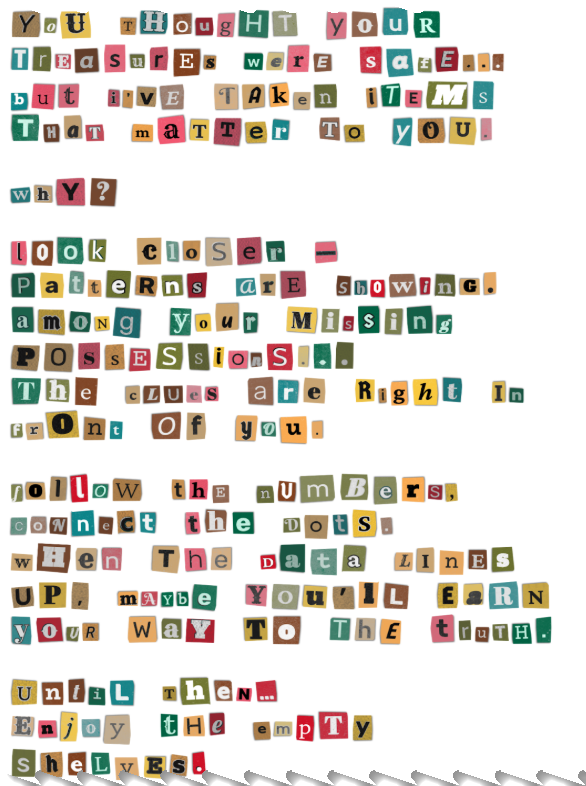
| QUEST 1: CLUE COLLECTION You will identify types of data sources, then gather and record relevant data to solve a mystery in your role as data detective. You will use digital forms and spreadsheets to collect evidence. QUEST 2: SPREADSHEET SECRETSYou will use spreadsheets to track the facts, spot patterns, and connect the dots. Your goal is to organize everything you uncover about the missing collectibles. QUEST 3: ORDER IN THE CLUE ROOMYou will learn how to categorize different types of data, use sorting and filtering tools in Google Sheets or Excel, and spot patterns and connections that lead to clues. By organizing information carefully and thinking critically, you’ll start to uncover the truth behind the mystery. |
Before moving on in the Quests, let's make sure we all have a basic understanding of the word - data!
Play the video below, then answer the questions on a piece of paper or in the place where you keep your online notes. Be prepared to do a quick share-out with the class or a partner, depending on your teacher's instructions.
- What is data?
- How do we collect data?
- How do we organize data?
- What is data visualization?
What is Data?
Direct link (1:31 min.)
QUEST 4: VISUALIZING THE CLUES You will learn how to turn your data into visuals that reveal what the numbers are really saying. By creating and interpreting pie and column charts, you’ll spot patterns, make connections, and share your discoveries like a true Data Detective. QUEST 5: CASE CRACKING FORMULAS You will learn how to build powerful spreadsheet formulas and functions; adding, averaging, and spotting mistakes, so your data works for you and helps uncover the truth hidden in the clues. QUEST 6: MAKE YOUR CASE You will analyze your notebook data, choose your suspect, and turn your strongest evidence into a clear, convincing infographic that proves your case and helps others see exactly how you cracked the mystery. QUEST 7: DATA DETECTIVES DIGITAL BREAKOUT You will test your data detective smarts by unlocking clues and solving puzzles that connect back to the key skills you’ve learned in Quests 1–6. |
I have completed the Quests as assigned by my teacher.
I am ready for the graduation page for this Thing.




Awesome Index & Report a Bad Link
AWESOME INDEX
Use the Awesome Index to sort by Thing#Quest#, Technology Standards, Interactive/Self-Guided activities, Key Vocabulary, Content Area, Teacher Guides, and Applications.
REPORT A BAD LINK
If you discover a bad link or outdated content, please use the Bad Link report to notify us.
Websites and Applications
Videos
- 21T4S T13 Data Detectives Intro (1:31 min.)
- Data for Kids ~ What is Data (1:31 min.)