



Q4 STEAM Roller Coaster: Plan
Plan your coaster
Step 1. Check with your teacher and/or design partners, and create a note-taking document to take notes on your design decisions. Discuss and decide:
- What note-taking application will you use? (Google Docs, Word, Pages, a graphic organizer, or other?)
- Will one partner take the notes or will each person take turns
- Will the note-taking document be a shared document you can all edit?
Step 2. Use the Design a Roller Coaster website for this activity.

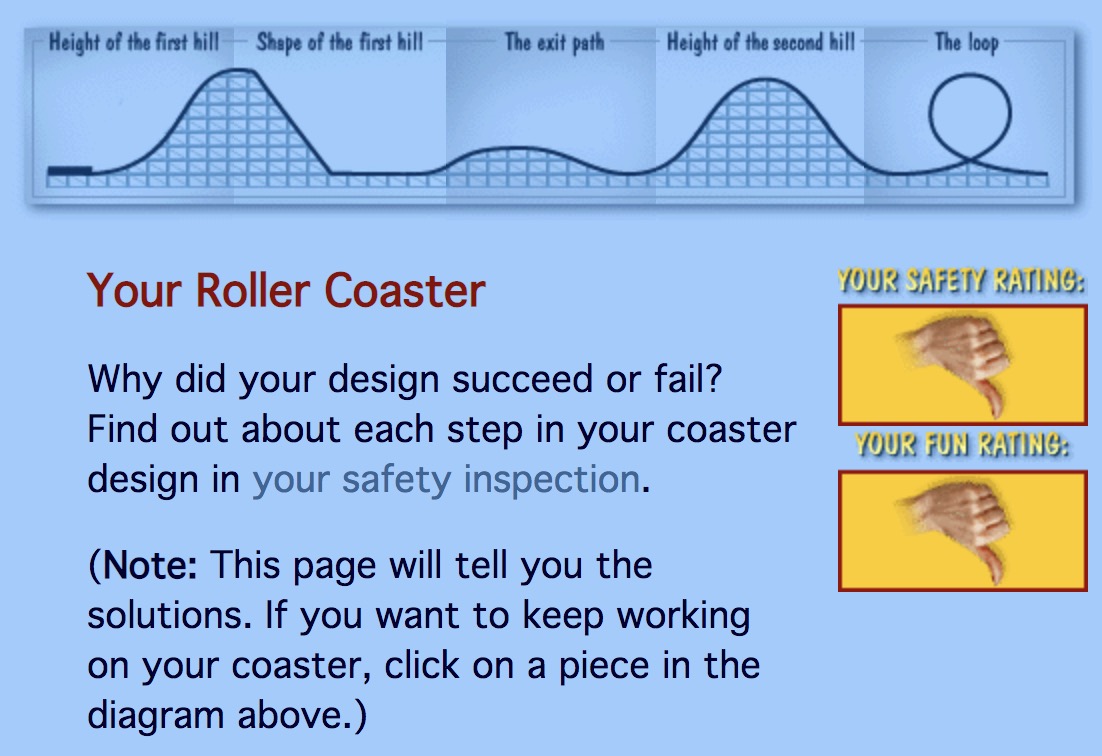
Step 3. Select the height and shape of the first hill, an exit path, the height of the second hill, and create a loop. Below is a screenshot of a design that received two thumbs down for safety and fun. Can you create a design that gets a thumbs-up?
Step 4. What are some key concepts based on your research about applying kinetic and potential energy physics to create a safe and fun roller coaster?
Step 5. Go onto the next page and answer the questions in your note-taking document using the vocabulary terms (Potential and kinetic energy, energy loss, friction, mass, velocity, gravity).

Competencies & Standards
MITECS Michigan Integrated Technology Competencies for Students, and
3. Knowledge Constructor
c. Students curate information from digital resources using a variety of tools and methods to create collections of artifacts that demonstrate meaningful connections or conclusions.
4. Innovative Designer
a. Students know and use a deliberate design process for generating ideas, testing theories, creating innovative artifacts or solving authentic problems.
b. Students select and use digital tools to plan and manage a design process that considers design constraints and calculated risks.
c. Students develop, test and refine prototypes as part of a cyclical design process.
d. Students exhibit a tolerance for ambiguity, perseverance and the capacity to work with open-ended problems.
5. Computational Thinker
b. Students collect data or identify relevant data sets, use digital tools to analyze them and represent data in various ways to facilitate problem-solving and decision-making.
Websites and Documents
Websites
- Amusement Parks Physics
- ck-12 Physics Simulations
- Design a Roller Coaster
- Five-step Engineering Process
- How Roller Coasters Work
- How Stuff Works - Roller Coasters
Videos From Outside Sources
- Dad Builds Backyard Roller Coaster YouTube
- How Can a Roller Coaster go Upside Down without Falling? PBS Kids Video
- I Built a Huge Lego Roller Coaster Floor to Ceiling YouTube
21t4s Videos
- None
21t4s Documents & Quizzes