

Q2 Global & Local Lens: Research Roadmap
Your Global to Local Work
The goals you explored and then picked one as your passion were presented on the global scale from the United Nations. Now, let transition from thinking globally to researching locally.
Step 1. Finding your search terms.
- Global terms like "Sustainable Cities" might not pull up small, local groups.
- Individually, brainstorm at least 3 local keywords related to your goal.
- For example some keyword for Zero Hunger and Climate Action are below:
- SDG 2 (Zero Hunger): Food pantry, community garden, soup kitchen, food rescue network.
- SDG 13 (Climate Action): Tree planting initiative, local recycling collective, bike path advocacy groups.
- For example some keyword for Zero Hunger and Climate Action are below:
Step 2. Run your local search and track down organizations near you that might have a focus on your goal.
- Use search engines to combine your keywords with the name of your town, city, or county (e.g., "food pantry Kalamazoo county" or "community garden Detroit").
- Don't just look at websites—check local news sites, your town's community board, or social media pages to see who is currently active.
- Find 2-3 organizations that fit your search.
Searching Nonprofits Near You
Partnering with a local nonprofit organization is a great way to turn your Global Goal into real-world action! These organizations have experience tackling challenges in your community, and connecting with them can help you learn from experts, discover new perspectives, and find meaningful ways to make a difference.
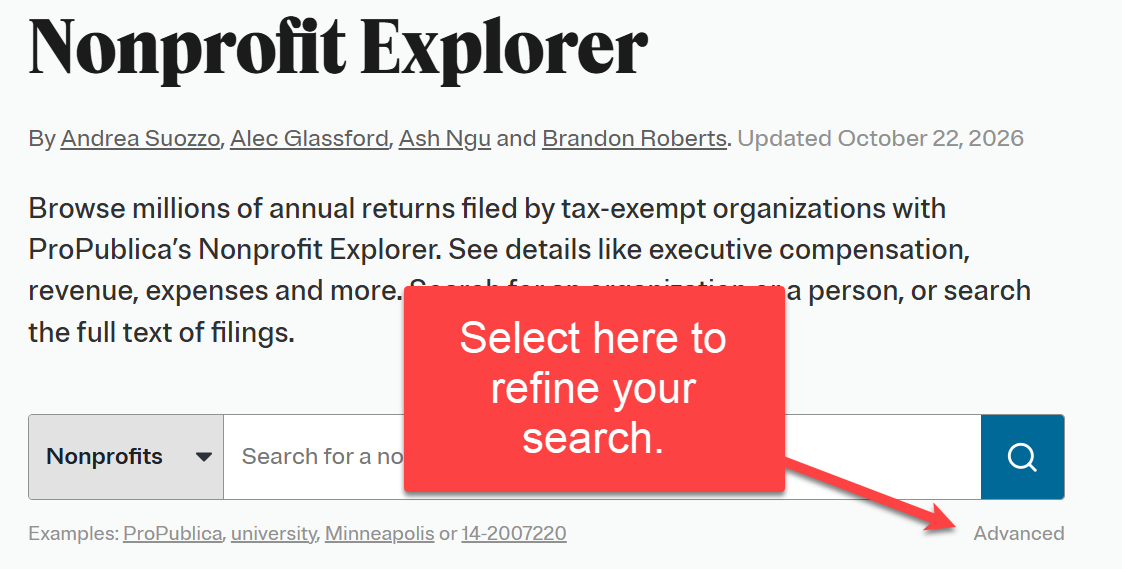
Step 3. To help further your search, check out the Propublica Nonprofit Explorer.
- By clicking Advanced, you can search by Michigan (or whichever state you live).
To narrow it down closer to where you live, type your Goal and your town/city.

Competencies & Standards
MITECS Michigan Integrated Technology Competencies for Students, and
1. Empowered Learner
a. Articulate and set personal learning goals, develop strategies leveraging technology to achieve them and reflect on the learning process itself to improve learning outcomes
2. Digital Citizen
a. Cultivate and manage their digital identity and reputation and are aware of the permanence of their actions in the digital world
b. Engage in positive, safe, legal and ethical behavior when using technology, including social interactions online or when using networked devices
c. Demonstrate an understanding of and respect for the rights and obligations of using and sharing intellectual property
3. Knowledge Constructor
d. Curate information from digital resources using a variety of tools and methods to create collections of artifacts that demonstrate meaningful connections or conclusions
6. Creative Communicator
b. Create original works or responsibly repurpose or remix digital resources into new creations
c. Communicate complex ideas clearly and effectively by creating or using a variety of digital objects such as visualizations, models or simulations
d. Publish or present content that customizes the message and medium for their intended audiences
7. Global Collaborator
c. Contribute constructively to project teams, assuming various roles and responsibilities to work effectively toward a common goal
d. Explore local and global issues and use collaborative technologies to work with others to investigate solutions